


-
We can also call tummy time "abdominal activity time".
-
With this activity, babies are laid face down on their stomachs.
-
Thus, the baby works his muscles by trying to crawl or crawl.
-
Babies start walking towards the age of 1.
-
Learns some movement skills in the process.
-
It is of great benefit for the baby to gain movement skills such as turning while lying down, supported sitting, sitting without support, crawling, standing up, lying on the abdomen and developing his/her muscles.
-
Babies who spend a lot of time on the snow gain these skills more easily.
-
It helps the muscles in the shoulder, leg, abdomen, back and neck to work.
-
Supports body stability and head control.
-
Develops motor skills such as crawling, turning, and holding on.
-
Accelerates the crawling process, which is the way to walk.
-
Since the baby does not lie on his back all the time, the risk of getting the flat shape of the back of the head decreases.
-
Positions that can be applied for above-the-abdomen times are as follows:
-
Abdomen to abdomen: The baby is laid on the mother's womb and supported from the sides.
-
Eye level: While the baby is lying on the floor on his stomach, the mother lies in front of him in the same way.
-
On the lap: The baby is laid on the mother's knees as in the flatus position.
-
Abdominal carrying: One arm of the mother is passed through the leg of the baby, the mother supports the baby by the shoulder and head with the other arm.
-
Supported method: The baby lying on the abdomen is supported by rolling the towel under the arms.
-
Although baby-specific movements improve her physical health, it is necessary to catch the right time.
-
But this is not the case for abdominal activity.
-
You can start this activity even when your baby is 2 weeks old.
-
Of course, you need to know the answer to the question "How is tummy time done?" and what you need to pay attention to.
-
When your baby is 2 weeks old, start the activity with short sessions between 30 seconds and one minute.
-
Try to place your newborn's belly on your chest or lap.
-
So you can get him used to this position on a soft ground, under your control.
-
After the 2nd month, you can apply this activity for 5 minutes in 3 sessions.
-
After 4 months, your baby may be strong enough to start rolling along his belly.
-
For this, you can extend the time up to 15 minutes.
-
In the 5-6 month period, you can witness him/her turning freely using his/her stomach and using his/her arms.
-
After this period, she will be able to stand on her belly as much as she wants.
-
That's why it's best to leave the decision to him.
-
You just encourage it.
-
You can make time for tummy time by scheduling at certain times of the day for your baby, who needs to get support from you to work the muscles he/she does not use in his/her body.
-
You can have fun with tummy time when your baby is not sleeping during the day to improve your physical development and coordination skills.
-
Abdominal times support not only your baby's physical development but also his mental development.
-
Tummy time, which also allows your baby to see and explore his/her surroundings, improves your baby's sense of discovery.
-
Thanks to the activities on the abdomen, your baby, whose muscles become stronger and whose mobility increases, feels more independent over time.
-
It would be a great pleasure for you to watch it at these times.
-
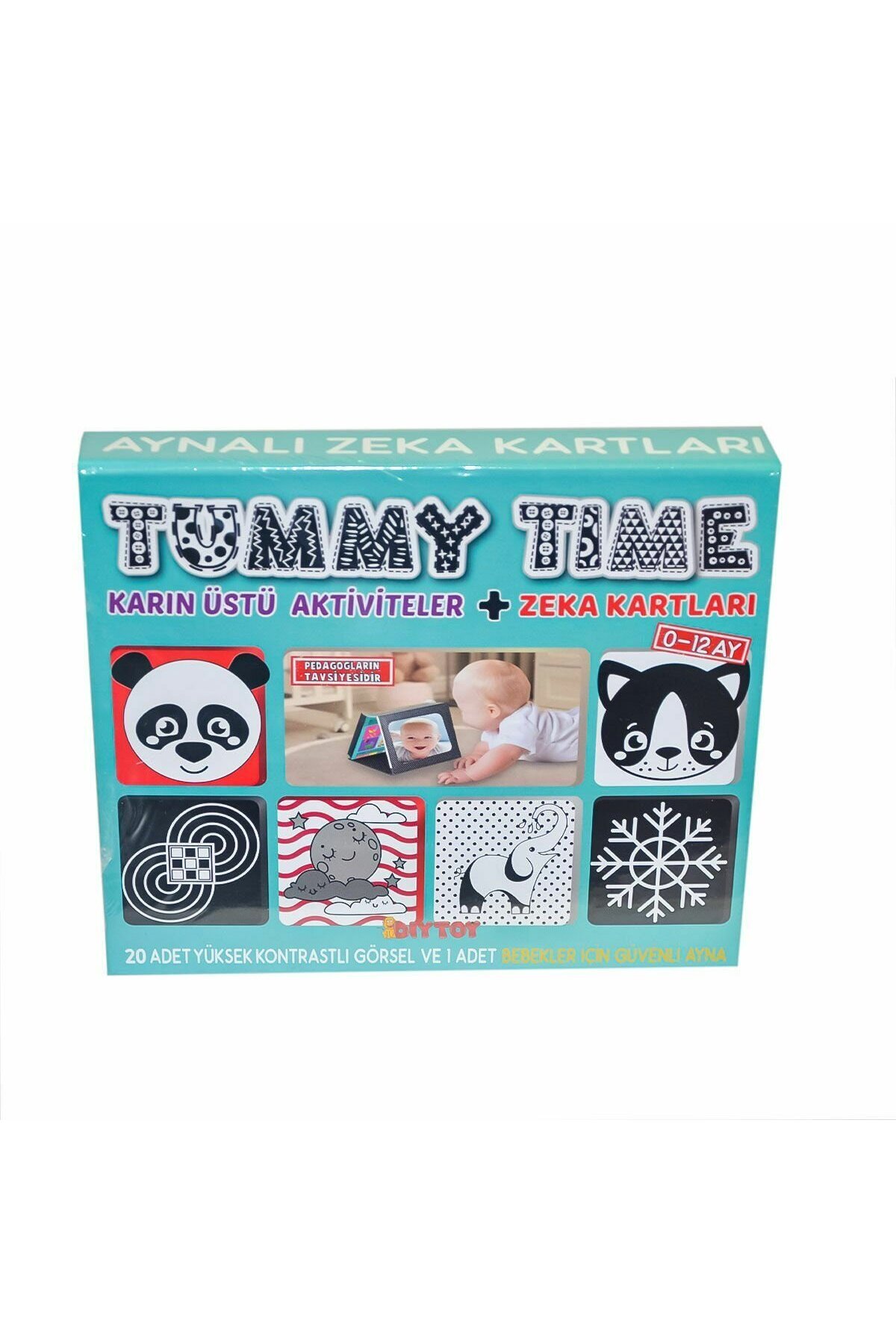
There are 20 cards and 1 safe mirror for babies.
-
Box Dimensions: 20 x 17 x 4 cm
•
•
•
•
•
•
•
•
•
•

favorite
account_circle
shopping_bag
Cart Catalogue
